Shell: Fuel, Charge & More
- 3.1
- Rating
- 1.00M
- Installs
- Free
- Price

 Analysis by App-foxy
I tested Shell: Fuel, Charge & More as a practical companion for everyday driving, and its value becomes clearer when more than one person uses the same car. The app is aimed at fuel and charging routines rather than general trip planning, so I found it most useful when I wanted to make a stop, check the available Shell options, and keep fuel-related tasks in one place. It is free to use, rated for Everyone, and developed by Shell Information Technology International B.V.
That shared-car angle matters. In a household, one person may drive to work, another may handle school runs, and someone else may take the car on a weekend trip. A fuel app can reduce small misunderstandings, but it does not automatically turn into a family management system. My experience is that each person should understand whose account is being used, who is responsible for a purchase, and whether the phone currently has the right login before relying on it at a busy station.
How Shell: Fuel, Charge & More fits a shared car
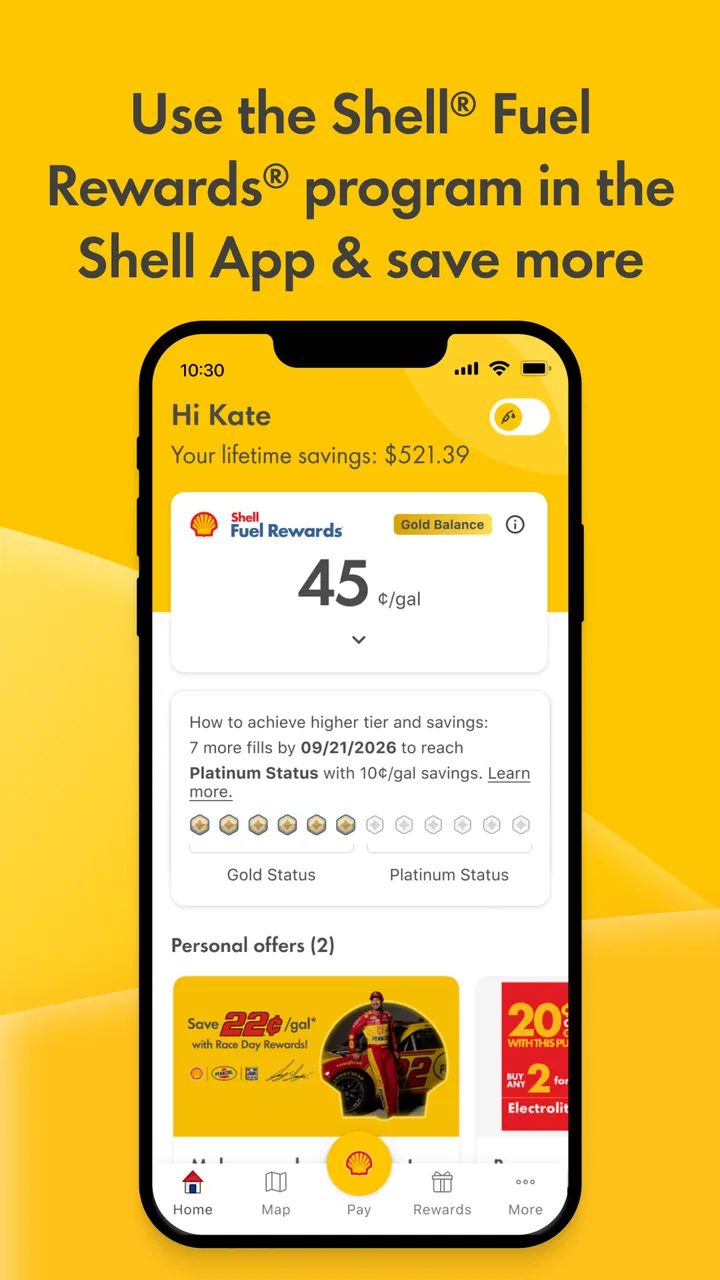
The first thing I noticed is that this is not simply a digital replacement for a paper receipt. Its purpose is to connect the driver with Shell’s fuel and charging ecosystem. The store summary focuses on earning and saving with Fuel Rewards®, while the short description is simply Shell, so the app feels intentionally centered on the company’s own services rather than on comparing every possible station from every provider.
You May Also Like

 Blood Strike: 2.5 Anniversary
Blood Strike’s Loadouts Turn Every Drop Into a Tactical Gamble
A close look at Blood Strike’s custom loadouts: how fast access to signature weapons reshapes its battle royale rhythm, rewards preparation, and narrows the gap between fights.

 Pandora - Music & Podcasts
Pandora’s Music Is Easy to Start, but Harder to Recover
Pandora’s strength is its low-effort path from a seed to a station. Its weak spot is how much confidence it asks you to place in connection, setup, and quiet recovery.

 8 Ball Pool
 Is Built on Rivalries, Rematches, and Routine
A close look at the rivalries, rematches, shared routines, and unanswered safety questions that turn a quick pool match into a persistent mobile community.

 Samsung Music
’s Quiet Strength Is Playing What You Already Own
Its reach comes less from spectacle than from dependable access to a personal library. That simplicity is both the app’s strongest retention engine and its ceiling.

 AccuWeather: Weather Radar
AccuWeather Review: A Quick, Clear Forecast for Everyday Decisions
For everyday plans, the best forecast is the one you can understand quickly. AccuWeather makes rain timing, radar, and local conditions easy to act on, with a few trade-offs.

 Hill Climb Racing
Why Hill Climb Racing Still Turns Crashes Into One More Run
A tiny car, a bumpy hill and one more upgrade: Hill Climb Racing keeps resurfacing because its simple chaos makes every near-miss feel personal.
More From Our News Desk



For a driver who regularly visits Shell locations, that focus can be convenient. Instead of switching between a general map, a loyalty tool, and a separate charging application, I can start with the Shell app and see whether it fits the stop I am planning. The benefit is less about one spectacular feature and more about having a familiar starting point when Shell is already part of my normal driving routine.
In a shared household, the practical scenario is easy to imagine. I might use the car in the morning, leave it with a low fuel level, and expect another household member to use it later. If that person opens the app before leaving, they can plan around a Shell stop rather than discovering the problem halfway through the trip. The app does not replace a quick conversation, but it gives the driver a more direct way to organize the next fuel or charging decision.
I would not install it just because I occasionally pass a Shell station. The strongest case is repeated use: a regular commute, a shared vehicle, or a household that already prefers Shell. If your driving is spread across many brands and you mainly want the cheapest nearby option, a broad fuel-price comparison tool may be a better first choice. This app makes more sense when the Shell relationship itself is useful to you.
Setting it up without blurring account boundaries
On a personal phone, setup is fairly easy to understand: install the app, sign in or create the relevant account, and explore the fuel and charging functions before you need them. My advice is not to wait until the car is nearly empty. A calm setup at home gives you time to check the account you are using and become familiar with the screens that matter during a stop.
Shared devices need a little more care. If a family tablet or a spare phone is used by several drivers, leaving one person permanently signed in can create confusion. The next driver may assume the displayed account belongs to them, or may accidentally use a payment or rewards arrangement that was intended for someone else. I would treat the account as personal unless the people using the device have explicitly agreed on how it should be handled.
This is one of the app’s less obvious household considerations: the phone is shared, but the account context may not be. Before a long trip, I would check the displayed profile, confirm that the correct driver is using the device, and avoid handing the phone to a child simply because the app is marked for Everyone. An age rating describes suitability of content; it does not decide who should authorize a purchase or manage a rewards account.
Another useful habit is to prepare the app before leaving a familiar network. Open it at home, make sure you can sign in, and check that the driver knows what the app is being used for. This is especially helpful when one household member normally handles the account while another person does most of the driving. The goal is not to create complicated rules, but to prevent a rushed stop from becoming an account-recovery exercise.
The app’s minimum operating-system requirement is Android 7.0, which makes it accessible on many older Android phones. That is helpful for a shared vehicle where the designated phone is not the newest model. Still, an older handset may be slower to operate, and a driver should never be trying to solve a login issue while moving. I would complete anything that requires attention before starting the car.
Coordinating fuel, charging, and everyday errands
Shell: Fuel, Charge & More is most useful when it becomes part of a routine rather than an app opened once and forgotten. I would use it before a weekly shopping trip if the tank or battery needs attention, or before handing the car to another driver for a longer journey. That small check can help the household decide whether the next stop should be planned around fuel, charging, or simply the destination.
The charging side is important for households with an electric vehicle or a plug-in routine. Fuel and charging are different tasks, and a shared car can make that distinction easy to overlook. One person may return the vehicle assuming the next driver will charge it, while the next driver expects it to be ready. Using the app as part of the handover creates a simple prompt: check the vehicle’s current state and decide who is responsible for the next stop.
I found that the best workflow is to separate planning from payment responsibility. The driver can use the app to think through where to stop, while the account holder remains clear about which account is active and who is approving the transaction. That division is particularly useful in a household where one adult manages vehicle expenses but another adult or older teenager drives the car.
A second non-obvious tip is to agree on a handover rule that does not depend on the app alone. For example, the person returning the car can mention whether fuel or charging is needed, and the next driver can verify the situation in the vehicle and in the app. This avoids treating a digital screen as a perfect substitute for real-world information. Apps help coordinate, but the car’s actual fuel gauge or battery display remains the immediate reference.
Rewards can also affect coordination. If several people use the same household account, decide whether rewards are shared or treated as belonging to one driver. Without that conversation, a supposedly small benefit can become surprisingly awkward. The app may make earning and saving more visible, but it cannot settle a family’s preferred arrangement for who gets credit for a stop.
For business drivers or people who need detailed expense records, I would be more cautious. The app may be convenient for the stop itself, but a household-style account is not automatically the same thing as a formal mileage or accounting workflow. If your main requirement is strict reimbursement documentation, a dedicated expense process may still be necessary alongside Shell’s app.
What the app feels like in real use
The interface is built around a clear automotive purpose, which I appreciate. I do not have to treat it like a social network or a general-purpose travel planner. The useful mindset is to open it with a specific question: where can I handle my next Shell fuel or charging need, and how does my account fit into that stop?
That narrow purpose is both a strength and a limitation. It keeps the experience relevant for Shell customers, but it may feel restrictive if you expect a complete driving dashboard. I would not choose it as my only navigation tool, route planner, or vehicle-maintenance organizer. A maps app remains better for the full journey, while Shell’s app is better understood as a brand-specific stop and rewards companion.
The public response reflects a mixed experience, with an average rating of 3.2 from around twenty-six thousand ratings and roughly seven thousand reviews. I read that as a reason to keep expectations practical rather than assuming every account, device, or station visit will feel effortless. The app has a substantial audience, with over one million installs, but popularity does not remove the need to test the workflow on your own phone before depending on it during a trip.
One friction point with any account-based fuel app is that the most important moment often happens when the driver is in a hurry. A household can reduce that pressure by having every regular driver open the app in advance, learn where the relevant account information appears, and understand whether they are using it for planning, rewards, payment, or all three. That preparation is more valuable than simply downloading it and assuming the first live use will be obvious.
I also recommend keeping expectations realistic about shared phones. If the app is installed on a device used by several people, notifications, saved sessions, and account screens can be interpreted differently by each driver. I would avoid sharing a device casually when a transaction is about to happen. Handing over the phone at the station may be convenient, but confirming the account before the stop is safer and less confusing.
Age, trust, and responsible household use
Because the app carries an Everyone content rating, it is not presented as an age-restricted entertainment product. That does not mean every function should be delegated to every member of the household. Fuel and charging can involve money, account access, and decisions about the family vehicle, so trust and responsibility matter more than the rating alone.
For younger household members, I would use the app as a learning aid rather than an unsupervised payment tool. They can understand how a fuel stop fits into a journey, help check whether the car needs attention, or learn why a shared vehicle should be returned ready for the next driver. An adult should still decide how account access and purchases are handled.
For teenagers who drive independently, the useful conversation is about boundaries. Which account should they use? Are they allowed to redeem rewards? Should they report every stop? What should they do if the app does not behave as expected? These are household decisions, not features I would assume the app makes automatically. Clear rules prevent the common mistake of treating convenience as permission.
Trust also matters between adults. A couple or group of housemates may be happy to share rewards, or may prefer separate accounts even when they share a car. I would decide that before linking the app to a routine. If privacy between drivers is important, a shared device may be the wrong arrangement; separate phones and clearly owned accounts are easier to understand.
The same principle applies to an older family member who is less comfortable with smartphone apps. I would set up the app together, explain only the screens they need, and keep a non-digital fallback in mind. No driver should feel forced to depend on a phone for a basic fuel stop if they are not confident using it. The app can simplify a routine, but it should not become a source of anxiety.
Who should use it, and who should look elsewhere?
I would recommend Shell: Fuel, Charge & More to drivers who already choose Shell often, want fuel and charging tasks gathered in one place, or share a vehicle with people who can agree on account responsibility. It is also a reasonable choice for someone who wants to explore Fuel Rewards® while keeping the process connected to the Shell brand.
I would be less enthusiastic for drivers whose top priority is scanning every nearby provider for the lowest price. A multi-brand fuel finder is likely to serve that purpose more directly. The same applies if you need a full travel planner, detailed vehicle maintenance log, or a dedicated household budget tool. Shell’s app has a specific job, and it is better judged on that job than on functions outside it.
It may also be a poor fit for a household that cannot agree on shared access. If one person wants a personal account, another wants a communal account, and a third uses the same phone without checking who is signed in, the convenience quickly turns into uncertainty. In that situation, a simpler arrangement with clearly separate accounts may be preferable, even if it means using more than one app.
Before committing to it for a road trip, I would answer four practical questions: Do I regularly use Shell? Does the app fit my fuel or charging routine? Does every regular driver know which account is active? And am I comfortable using it alongside, rather than instead of, navigation and other driving tools? If the answers are mostly yes, the app has a sensible place on the phone.
Its free price makes trying it low-risk, and the Everyone rating means it can sit comfortably in a household’s general app collection. The current version is 8.12.0, so I would keep it updated through the normal app-store process, especially if the phone is shared and different drivers rely on it at different times. Updates are easiest to manage before a journey, not at the pump or charging point.
My household verdict
After using it as a fuel and charging companion, I see Shell: Fuel, Charge & More as a focused tool rather than an all-purpose driving solution. Its real strength is the connection between Shell stops, Fuel Rewards®, and the everyday decisions that come with using a car. In a shared household, it can support coordination, but only when account ownership and spending expectations are discussed clearly.
I especially like the idea of using it during vehicle handovers: check the car, open the app before leaving, and make sure the next fuel or charging responsibility is understood. That workflow is more valuable than treating the app as a passive loyalty card. It turns a small digital check into a practical part of the household routine.
My main reservation is that the app’s usefulness depends heavily on your relationship with Shell and on how well your household manages shared access. Drivers who want brand-neutral price comparisons or a complete navigation experience should choose a different primary tool. Drivers who frequently use Shell and want a dedicated way to organize those stops have a stronger reason to keep it installed.
Overall, I would recommend it to a Shell-using household that values convenience but is willing to keep account boundaries clear. The best experience comes from treating the app as a shared-car coordination aid, not as a substitute for communication or judgment. Used that way, it earns its place on my phone; used without clear responsibility, it can add confusion to a task that should be simple.
FAQs for Shell: Fuel, Charge & More
01What features does the Shell: Fuel, Charge & More app offer?
The Shell: Fuel, Charge & More app provides a range of features designed to enhance your fueling experience. Users can locate nearby Shell stations, check fuel prices, and access charging stations for electric vehicles. Additionally, the app offers loyalty rewards, enabling users to earn points and redeem them for discounts and special offers.
02Is the Shell app compatible with both Android and iOS devices?
Yes, the Shell: Fuel, Charge & More app is available for both Android and iOS platforms. Users can download the app from the Google Play Store for Android devices and the Apple App Store for iOS devices, ensuring a seamless experience across different operating systems.
03How does the loyalty program in the Shell app work?
The loyalty program within the Shell app allows users to earn points with every purchase made at Shell stations. These points can be accumulated and redeemed for discounts on fuel and in-store purchases. The app frequently updates users on their point balance and available promotions, making it easy to maximize savings.
04Can I use the Shell app to pay for fuel directly from my phone?
Yes, the Shell app includes a mobile payment feature that allows users to pay for fuel directly through their smartphones. This convenient option minimizes the need for physical cash or cards, enhancing safety and efficiency at the pump. Payment can be completed using linked bank accounts or credit cards.
05Does the app provide real-time updates on fuel prices and station availability?
The Shell: Fuel, Charge & More app offers real-time updates on fuel prices, ensuring users have the latest information before making a purchase. The app also provides details on station availability, including which locations offer specific services like EV charging, car washes, and convenience stores, helping users plan their visits accordingly.
Pros
- User-friendly interface for easy navigation.
- Integrated fuel station locator saves time.
- Real-time fuel price updates.
- Loyalty rewards program boosts savings.
- Secure payment options for peace of mind.
Cons
- Limited to Shell stations only.
- Occasional app crashes reported.
- Requires constant internet connection.
- Location tracking can drain battery.
- Limited features for electric vehicles.

Shell: Fuel, Charge & More
Gallery